Friday, February 10, 2006

Paper Chef #15

It is time for one of my favourite blog event: the Paper Chef contest! Paper Chef is a very informal and fun competition where participant are asked to prepare delicious dishes using four pre-selected ingredients. Each participant has the weekend to cook their creation and write about it. It is all done for the fun of working with different flavouring combinations and to appreciate the diversity of dishes produced by all participants.

This month I have the privilege of hosting and judging this edition of Paper Chef. Since I realize that a large numbers of my readers are French speakers who are able to read English but might feel discomfort with expressing themselves in this language (I sometimes still do), I would like to offer my help at translating a short paragraph describing their eventual contributions.

My partner Fufu will help me in the enjoyable but delicate task of judging each entry but before going any further, let’s have a look at the specifics of this edition.

Ingredients

Three ingredients have been randomly selected from the current Paper Chef ingredients list by Owen at Tomatilla. They are:


  1. Beets

  2. Pears

  3. Lime

This leaves the choice of a fourth ingredient to me. Since this is Valentine Day weekend, I think aphrodisiac ingredients are more than appropriate. I will leave the interpretation of what constitute an aphrodisiac to you but I do expect some kind of justification for your choices.

Hence, at the risk of repeating myself, the ingredients for this edition of Paper Chef are:

1. Beets
2. Pears
3. Lime
4. Aphrodisiacs


Rules (I hope I get them right)


  1. This event was created to be fun. As Owen, the creator of Paper Chef, puts it: “For absolutely only the fun of it and for no other reason whatsoever, the Paper Chef challenges each and every one of you reading this to let loose your culinary imagination and make up a dish of your own. Loosely based on the ideas of the Iron Chef, fond TV favorite in the US and Japan, and on the British show Ready, Steady, Cook! (fond favorite in the UK), the Paper Chef is all about creativity and constraint, challenge and cooking.”

  2. From this day (February the 10th, 2006) you have until Wednesday noonsih to publish your entry on your own blog and send me an email at “magictofu (at) gmail (dot) com”. Please include your name, the name of your blog, a permalink to your post and, if available, a picture of your dish that you would like to see on the round up (or more simply a link to this picture).

  3. If you do not own a blog, you can also participate by sending me your contribution by email at “magictofu (at) gmail (dot) com”, I will post them on this blog for the benefit of all.

  4. Substitutions of ingredients are allowed. If, for instance, you can’t find an ingredient, suffer from food allergies or simply do not like one of the chosen ingredients, do not refrain from participating. Simply select an appropriate substitute which would preserve the original character of the event.

  5. Have fun, be inventive and let us know about it!


Special prizes

Following some of my predecessors, I have created special prizes for this edition of Paper Chef. They are as follow:

Paper Chef Super Saver. Following the idea set forward by Noodle Cook, this special prize honors cooks who were able to prepare exquisite dishes with cheap ingredients or using inexpensive cooking techniques. If you plan on using caviar, foie gras or truffles, forget about this prize.

Paper Chef Indiana Jones for the most adventurous cooks. This prize has been created to pay homage to cooks who had enough courage to step outside their comfort zone by cooking unknown ingredients or attempting difficult recipes. Note: to win this prize, success is absolutely not required and honesty, in the case of culinary failure, might be rewarded with extra points.

Paper Chef Picasso. This prize rewards the best culinary works or art. You could chose to be as figurative or abstract as you want and even delve into conceptual art. This is the time to revise you high school art class and put your creative energy at work. Note: a picture or a short description of the ‘artistic value’ of your dish is necessary to be eligible for this prize.

Paper Chef Home Cook. Since I have the feeling that people more inclined to prepare home style comfort food have not been sufficiently rewarded for their work in previous editions of Paper Chef, I have created this special prize. It rewards food created for the family table which convey a certain sense of warmth and simplicity. Contrary to what some food magazines want you to believe, such food does not have to come from 1950s’ America; each of us, after all, have our own history and cultural background.

To simplify our task, we would love to read why you think your dishes fit one or more of the aforementioned categories. Put a nice twist on your creation by providing us with a certain perspective and entice our senses. This is not exactly a cooking competition but a food blogging event; as such, pictures, comments and descriptions carry some significant weight. Put us in context, show us your writing skills, entertain us with your whimsical humor, and, more than anything else, tell us about your experience.


A note about the judges.

Every judge and judging panels have their own bias. We believe that we should tell you as much as possible about our own tastes prior to the event.

Fufu, being of Chinese origin, tends to favor strong tastes and especially spiciness. She is also crazy for the very healthy fruits and vegetables as well as the less healthy charcuteries such as sausage and cured meat.

As for myself, being of French Canadian origin, I often crave protein: eggs, dairy products and meat (lumberjack food). Mushrooms and potatoes never fail to please my palate. Unlike Fufu, I prefer subtle flavors and aromas. Finally, again unlike Fufu, I am a total sucker for sauces: pasta sauce, demi-glaze sauce, stews…

These are our own little food bias but we will do our best to offer a fair judging. After reading entries from past Paper Chef editions, I can already speculate that this time again it won’t be an easy job.

A la cuisine!

Thursday, February 09, 2006

There is more to mash than just potatoes

Ah the marvels of mashed potatoes! They can be as chunky or as silky as the cook wants them to be and they take almost any flavour you fancy to throw at them. I grew up eating tons of mashed potatoes, digging little hole in them to make lakes of gravy, sometime decorating the shores with trees of broccoli and cauliflower. Some say mashed potatoes are the ultimate comfort food but that, of course, is subject to debate especially considering that it is a very western centered cultural assertion.


But potatoes are not the only roots which can be mashed with success. My mom, for instance, used to add turnip, carrots and parsnips to her delicious mashed potatoes. A recent discovery of mine was taro. It is a tropical root which is delicious in stews as it absorbs flavours like no other vegetables. It can also be mashed into one of the most luscious purée.

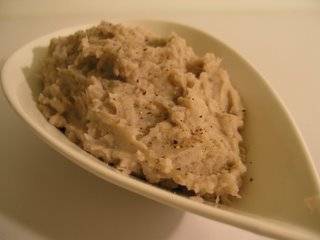
The idea is the same as mashed potatoes but you have to make sure your taro root is not too fibrous; chose younger and smaller specimen. If you are lucky enough, your purée will show a slight purplish-blue tinge but if, like myself, your taro roots are a bit pallid your purée might end up slightly greyish; it will still taste very good but might not be very pleasant visually once on your plate.

I personally add a touch of honey and black pepper to my taro purée. They both work very well together to accentuate the flavour of the root. Green onions or chive also add a nice finishing touch, especially if your purée turn out to be a little greyish.

Quel est ce légume? - What vegetable is that?

The answer and more details tomorow! - La réponse et plus d'information demain!


Wednesday, February 08, 2006

Sautéed watercress

.
.

I don't know why I feel so compelled to write this post. After all, I barely have a recipe to propose. Simple ingredients simply prepared are sometimes more appealing to me than the complex integration of rare ingredients.

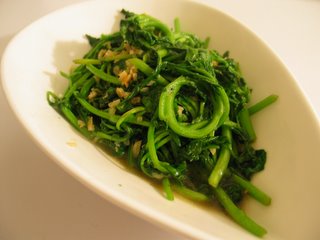
Here it is anyway, a Chinese classic: sautéed watercress with garlic. It resembles the equally simple chicory dish I made a few months ago but here the heat is key.

To prepare this delicious side dish, put a little bit of oil in a very hot pan or wok. I prefer peanut oil but feel free to use any oil which has a high smoking point. Add watercress to the pan along with some garlic. Stir often so that the watercress and the garlic do not burn. Add salt. Stir more and more and more… and then serve.

The very strong heat does wonders to the taste of watercress by adding a slightly toasty flavour. If your pan is so hot that everything burns however, just add a sprinkle of water to cool it down… this way at least you’ll save your watercress.

Tuesday, February 07, 2006

The egg test

What are the best tasting eggs available on the shelves of my local grocery store?

If eggs differ in taste in the same way as the animals that lay them, organic eggs should be noticeably more flavourful than their industrial counterparts.

I have discussed the tasteless character of North American industrial chicken before (here et ) and the always eloquent Kate of the Accidental Hedonist offered us her own set of explanations for this demoralizing culinary fact. The topic has also been addressed on other food blogs such as Blue Lotus. What prompted me to ask questions and do some research in the first place was the discovery of huge differences in taste between Canadian raised chicken and Chinese chicken as well as between organic and free range chicken and the usual industrially raised chicken from the average North American grocery store. Organic and free range chicken taste much better than industrial chicken but all the backyard raised chicken I tasted in China were even superior. Partial explanation to this problem can be found on the Accidental Hedonist as well as on Blue Lotus, the comments on both these posts are extremely interesting as well.

Now, what about eggs? They come from the same animal and, as my little experience abroad (again in China) also suggests, their taste can also vary greatly. To answer this question I bought a box of each of the three kinds of eggs available at my local grocery store (organic, regular and ‘Omega 3’ eggs). I then tasted each type with my dear Fufu. I made two very simple recipes so that no other ingredients interfered with tasting: hard boiled eggs and scrambled eggs. Here are the results.


Hard Boiled Eggs


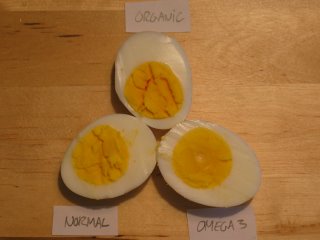
Visually all eggs were very similar. All had fairly pale yolks although the organic egg yolks were slightly darker. This was a bit disappointing since most of what I had read suggested that the darker the yolk, the better the flavour. And lets admit it, we also eat with our eyes and nice colours are always welcome on our plate.

Texture wise, they were all identical or at least none of us were unable to distinguish them from one another when considering their texture alone.

As for the taste, arguably the most important point in our little study, they were very little differences. For some reasons, before the test I believed that the ‘Omega 3’ eggs would have an off flavour but they were almost identical to the regular industrial eggs. The organic eggs were slightly better in my opinion but Fufu didn’t see any difference between them and the other eggs.

Scramble eggs


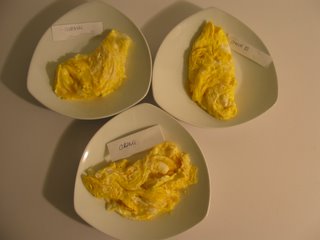
This time three ingredients were added in equal quantities: butter, milk and salt making the tasting a bit more challenging. The results from the scramble eggs test were nonetheless very similar to those of the hard boiled eggs test.

The color and texture of all eggs were practically identical and only at the taste test did I notice a barely perceptible improvement in the flavour of the organic eggs.


Conclusions

  1. Grocery store eggs pretty much all taste the same, including organic eggs. The very slight difference in taste that I perceived but that Fufu didn’t would be insignificant in any recipe. The way you cook your eggs is much more likely to affect the taste of the final dish. Eggs do not abide by the same rules as chicken it seems.
  2. That being said, I did try very good eggs in China and I believe better eggs could be available elsewhere than at the local supermarket.
  3. I am also in the belief that most grocery store eggs, being regular, ‘Omega 3’ or organic, are the product of industrial farms. What drives production is probably primarily economic: what counts is the number of eggs multiplied by their price on the market for each dollar invested. Smaller local farms might produce better quality eggs for a niche market of egg fanatics, I might have to investigate a bit further.
  4. On the other hand, unlike for chicken, I didn’t find the commercially available eggs to have any off taste but I grew up eating these eggs so I might be slightly biased.

Wednesday, February 01, 2006

It's ingredient nomination time for Paper Chef #15

You like the Paper Chef event? You want to participate or you just want to see what participants would do with various ingredients? Well it’s time to go nominate ingredients for the next edition of Paper Chef so go straight to Tomatilla and submit you ideas! Nominating an ingredient does not commit you to anything but believe me, participating in such event is a ton of fun.

If you don’t know yet what Paper Chef is, have a look at this. Fufu and I will happily judge the next edition so even if you don’t participate, come back here in about two weeks to see the round up and learn about the winners.