As you know, I took a few months off blogging and although having a weird work schedule preventing me from cooking as much as I would like, I did prepared a few nice dishes over the last months. For the most part, I did not take any pictures and my very poor memory does not allow me to recall exactly what I ate. Fortunately, I did take a few pictures here and there of certain dishes which I'd like to share with you. You won't find any recipes here as I forgot almost everything about these experiments but smart cooks might find ideas they might want to juggle with or offer comments on similar experiments of their own.
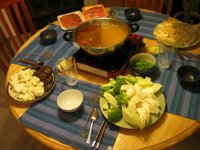
Chinese 'hot pot' or “
huo guo” (火锅): this is a winter favourite here at home and it certainly does not require long hours of preparation to enjoy. Like fondue, almost everything is cooked at the table in a variety of flavourful broths. The traditional Szechwan 'mala' broth is seasoned heavily with hot peppers and Szechwan peppers and can be very, very, very, very… spicy. As for myself, I love it the day I eat it and hate it the next day... I'm not sure I'll give more details here, but let’s just say that this dish is spicy for quite a long time after ingestion.
Living with my adorable Chinese partner, I often Chinese food at home. One of the great thing with Chinese cooking is that the produce needed are usually fairly cheap (e.g. cabbage, rice or tofu) but always delicious. Take that napa cabbage dish (the top left dish on the picture), it costs next to nothing, can be enjoyed year round and complement almost anything... and I bet dieticians would say that it is very healthy.

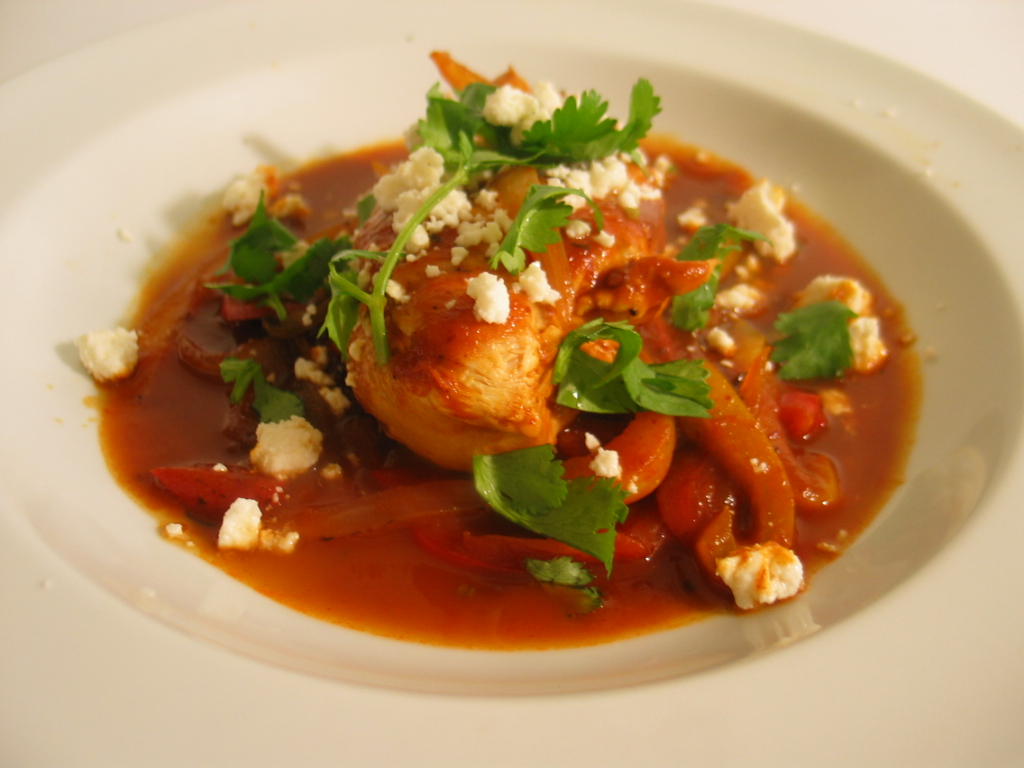
Now, back to North America... If memory serves me well, this dish is chicken in chipotle adobo sauce. Mexican and Americans living in the South West might laugh but true Mexican restaurants are almost nonexistent in this part of Canada and it takes some imagination and a trip to the local Latin-American grocery store to find out how Mexican food might taste like. I'm not so sure I did my job properly but this chicken did taste quite good with its cilantro and queso fresco toping. I have the feeling that roasted corn kennels would also make a nice toping here. Feel free to comment on this one, I still have a lot to learn about Mexican cuisine especially if it does not include taco or tortilla.

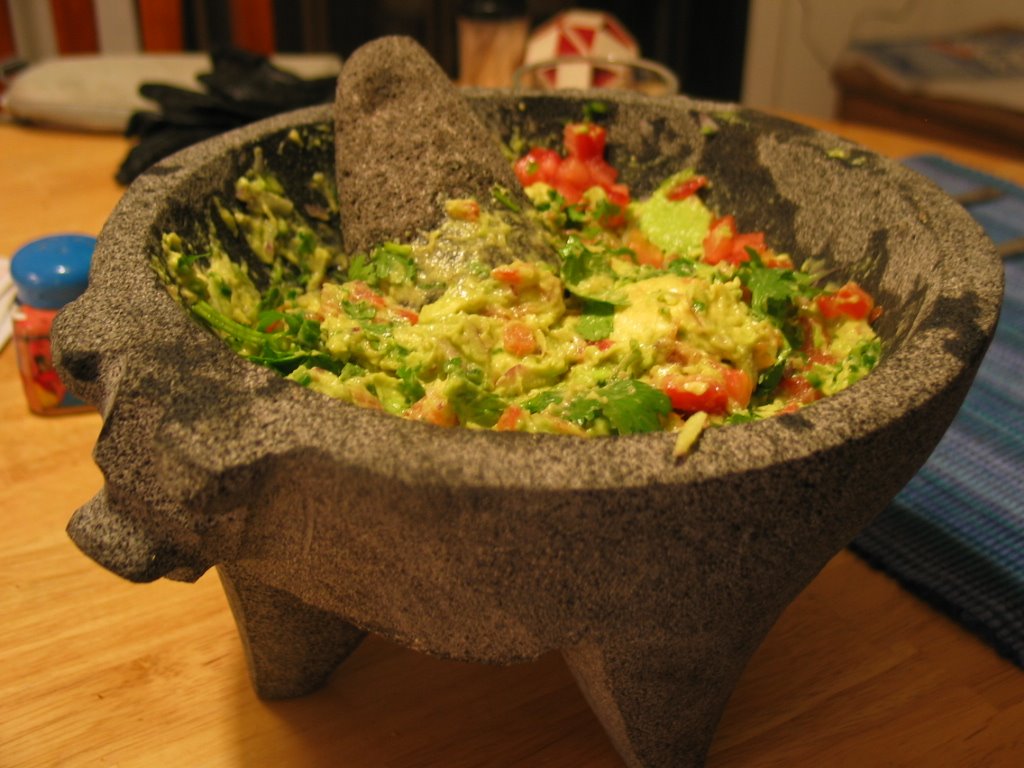
Another Mexican dish: guacamole. I went to Mexico City a few years ago for a conference. I didn't stay there long but took the time to visit the local markets. I found this beautiful molcajete (a Mexican mortar and pestle) made of volcanic rock. Unfortunately I haven't used this great cooking utensil that much but every time I make guacamole, it serves both as the preparation and serving bowl. Nothing says summer like guacamole, corn chips and cold beer so if you live in the northern hemisphere it is the right time to feel inspired.
Do you remember my
Jamaican inspired pig tail stew? After eating the stew, we still had quite a lot of delicious broth so we decided not to waste anything and cook lentils in it. That was perhaps my greatest culinary discovery of the year. All the flavours from the stew were there and the gelatine from the pig tail formed the most delicious and unctuous sauce one could imagine for lentils. I am now thinking of cooking all my lentils with pork hocks, tails or trotters... too bad for my vegetarian friends! I wonder if one could use agar agar and other vegetarian ingredients to achieve that level of legume goodness.

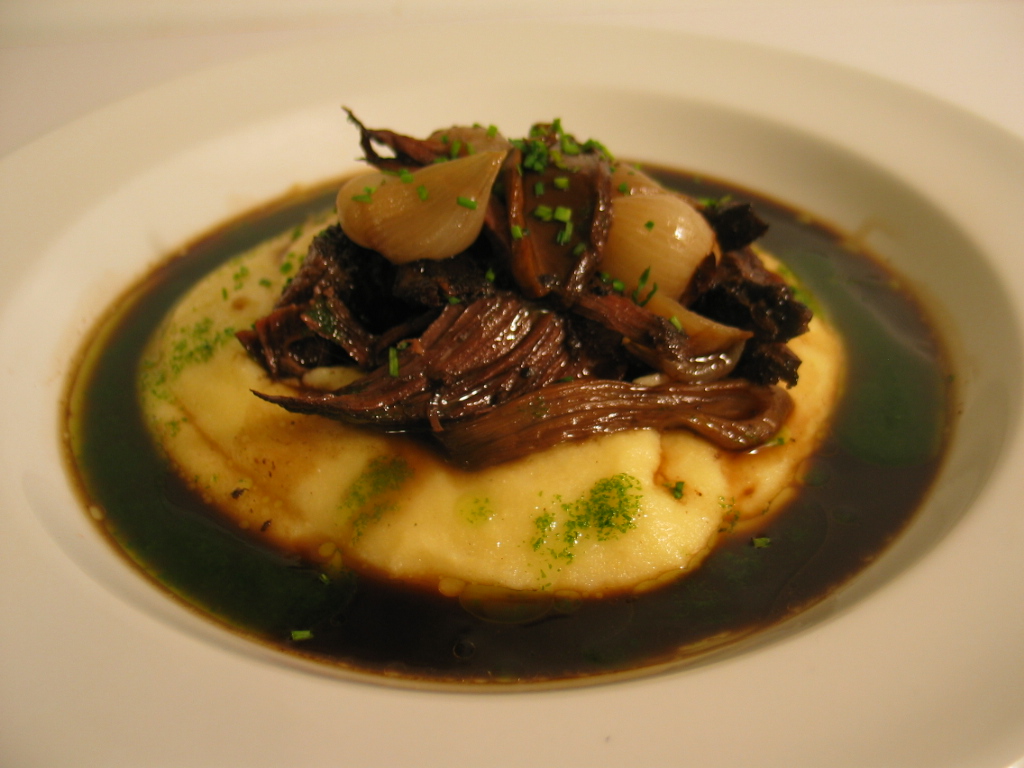
The fact about most meat is that there is only two ways of cooking it: you either both sear it and serve it rare to medium or you cook it for hours (smoke, braise, stew...) until it becomes deliciously tender. Almost anything in between is tough and chewy. In my family, beef blade roast has been on the table since long before I was born. It’s a very cheap but quite tough piece of meat with a huge bone in it. We usually cook it for hours with onions and mushrooms, sometimes a bit of wine and some thyme. The end result is always delicious and so is the resulting sauce. This sauce is worth any fancy and expensive sauce you could think of and should not be wasted under any circumstances. Mashed potatoes or egg noodles are perfect starches to soak up this sauce and so is polenta (as shown on this picture).

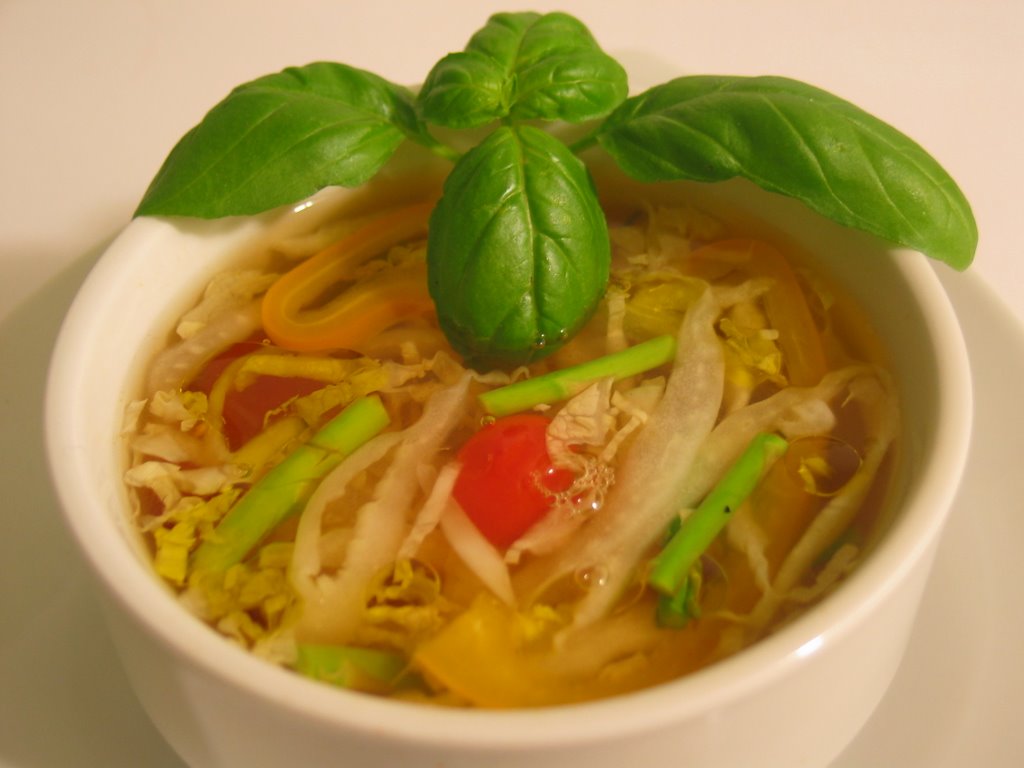
Sometimes however, what we crave for is more on the light side. This soup was made with a few vegetables that were sitting in the fridge. I don't recall what kind of broth I used but if I had to make a similar soup today, I would probably use a lemon grass (or maybe kefir lime leaves) and basil flavoured broth.

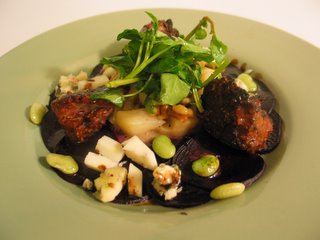
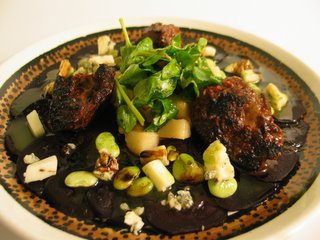
Another nice summery dish, especially now that fresh local beets started to appear in the markets, is a beet carpaccio.
Carpaccio is a fairly recent culinary invention born in Italy where ingredients are simply presented flat. It is usually made of raw beef tenderloin cut very finely but I don't see why one could not use anything edible... and many have done so. My version was made of beet roots sliced as finely as I could and served with the leaves sautéed in a little bit of oil and a curry mayonnaise. Let's just say that it was simpler version of one of my
Paper Chef (non) entry.

What can you do when your partner does not like chicken but you love it? Transform chicken into something else by adding tons of strong flavours. Fufu does not like chicken here in Canada. To her taste it is bland and mushy. After tasting some good organic chicken here and even better farm raised chicken in China, I understand her dislike of the generic industrial chicken that populate the shelves of supermarkets these days. Let's all be honest here: styrofoam plate chicken does not have much flavour and can be alarmingly tender (not always good thing). But it is also a perfect support for flavour, chicken has a fairly neutral flavour which seems to blend with almost anything. It is this very particularity that I decided to exploit for this honey and balsamic glazed chicken. The bed of root vegetables on which it was served also deserve attention but I'll try to address this in another post.
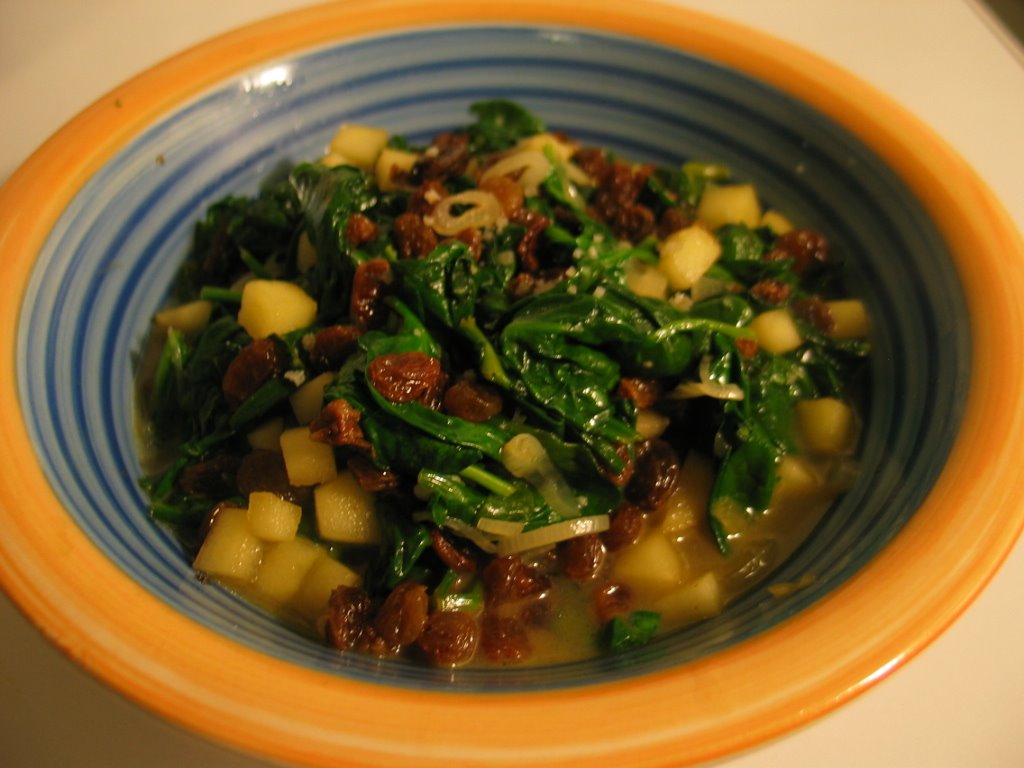
A last dish: spinach with apple and raisins in a sherry sauce. The verdict: good but a little too much on the sweet and acidic side. In other words, too much apple and raisins. Otherwise, a very nice flavour combination.
 Chinese 'hot pot' or “huo guo” (火锅): this is a winter favourite here at home and it certainly does not require long hours of preparation to enjoy. Like fondue, almost everything is cooked at the table in a variety of flavourful broths. The traditional Szechwan 'mala' broth is seasoned heavily with hot peppers and Szechwan peppers and can be very, very, very, very… spicy. As for myself, I love it the day I eat it and hate it the next day... I'm not sure I'll give more details here, but let’s just say that this dish is spicy for quite a long time after ingestion.
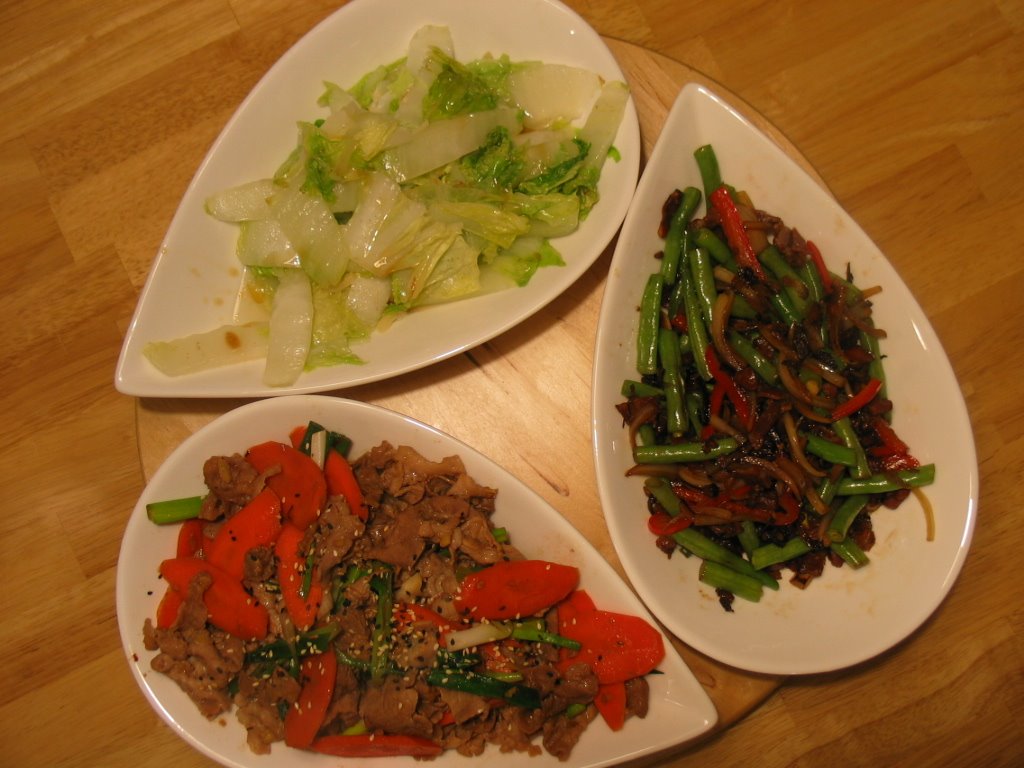 Living with my adorable Chinese partner, I often Chinese food at home. One of the great thing with Chinese cooking is that the produce needed are usually fairly cheap (e.g. cabbage, rice or tofu) but always delicious. Take that napa cabbage dish (the top left dish on the picture), it costs next to nothing, can be enjoyed year round and complement almost anything... and I bet dieticians would say that it is very healthy.
 Now, back to North America... If memory serves me well, this dish is chicken in chipotle adobo sauce. Mexican and Americans living in the South West might laugh but true Mexican restaurants are almost nonexistent in this part of Canada and it takes some imagination and a trip to the local Latin-American grocery store to find out how Mexican food might taste like. I'm not so sure I did my job properly but this chicken did taste quite good with its cilantro and queso fresco toping. I have the feeling that roasted corn kennels would also make a nice toping here. Feel free to comment on this one, I still have a lot to learn about Mexican cuisine especially if it does not include taco or tortilla.
 Another Mexican dish: guacamole. I went to Mexico City a few years ago for a conference. I didn't stay there long but took the time to visit the local markets. I found this beautiful molcajete (a Mexican mortar and pestle) made of volcanic rock. Unfortunately I haven't used this great cooking utensil that much but every time I make guacamole, it serves both as the preparation and serving bowl. Nothing says summer like guacamole, corn chips and cold beer so if you live in the northern hemisphere it is the right time to feel inspired.
 Do you remember my Jamaican inspired pig tail stew? After eating the stew, we still had quite a lot of delicious broth so we decided not to waste anything and cook lentils in it. That was perhaps my greatest culinary discovery of the year. All the flavours from the stew were there and the gelatine from the pig tail formed the most delicious and unctuous sauce one could imagine for lentils. I am now thinking of cooking all my lentils with pork hocks, tails or trotters... too bad for my vegetarian friends! I wonder if one could use agar agar and other vegetarian ingredients to achieve that level of legume goodness.
 The fact about most meat is that there is only two ways of cooking it: you either both sear it and serve it rare to medium or you cook it for hours (smoke, braise, stew...) until it becomes deliciously tender. Almost anything in between is tough and chewy. In my family, beef blade roast has been on the table since long before I was born. It’s a very cheap but quite tough piece of meat with a huge bone in it. We usually cook it for hours with onions and mushrooms, sometimes a bit of wine and some thyme. The end result is always delicious and so is the resulting sauce. This sauce is worth any fancy and expensive sauce you could think of and should not be wasted under any circumstances. Mashed potatoes or egg noodles are perfect starches to soak up this sauce and so is polenta (as shown on this picture).
 Sometimes however, what we crave for is more on the light side. This soup was made with a few vegetables that were sitting in the fridge. I don't recall what kind of broth I used but if I had to make a similar soup today, I would probably use a lemon grass (or maybe kefir lime leaves) and basil flavoured broth.
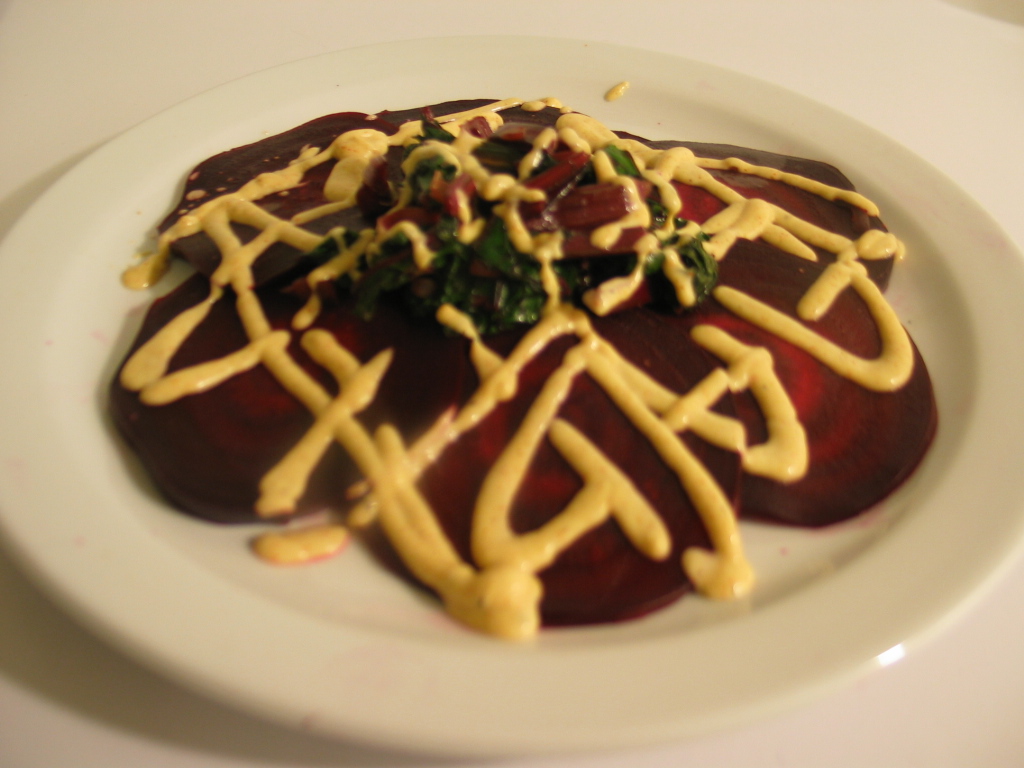 Another nice summery dish, especially now that fresh local beets started to appear in the markets, is a beet carpaccio. Carpaccio is a fairly recent culinary invention born in Italy where ingredients are simply presented flat. It is usually made of raw beef tenderloin cut very finely but I don't see why one could not use anything edible... and many have done so. My version was made of beet roots sliced as finely as I could and served with the leaves sautéed in a little bit of oil and a curry mayonnaise. Let's just say that it was simpler version of one of my Paper Chef (non) entry.
 What can you do when your partner does not like chicken but you love it? Transform chicken into something else by adding tons of strong flavours. Fufu does not like chicken here in Canada. To her taste it is bland and mushy. After tasting some good organic chicken here and even better farm raised chicken in China, I understand her dislike of the generic industrial chicken that populate the shelves of supermarkets these days. Let's all be honest here: styrofoam plate chicken does not have much flavour and can be alarmingly tender (not always good thing). But it is also a perfect support for flavour, chicken has a fairly neutral flavour which seems to blend with almost anything. It is this very particularity that I decided to exploit for this honey and balsamic glazed chicken. The bed of root vegetables on which it was served also deserve attention but I'll try to address this in another post.
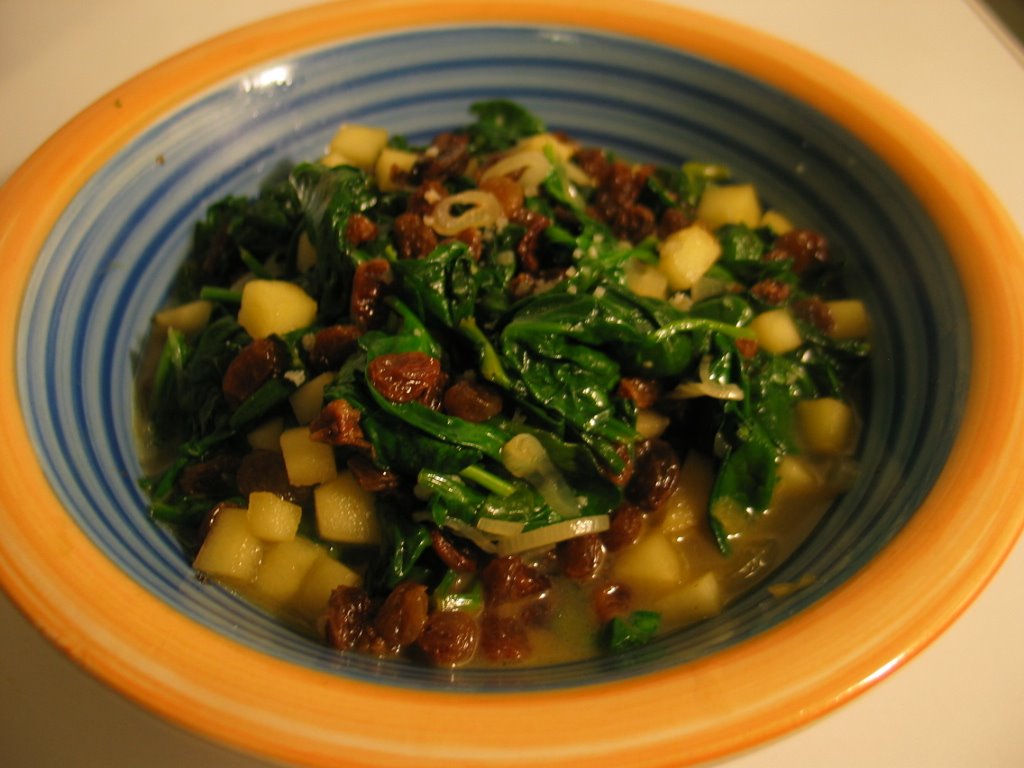 A last dish: spinach with apple and raisins in a sherry sauce. The verdict: good but a little too much on the sweet and acidic side. In other words, too much apple and raisins. Otherwise, a very nice flavour combination.